27th August 2022
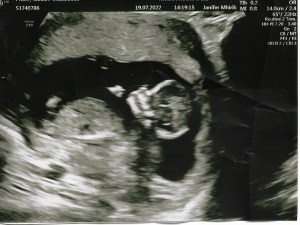
Scan of Sarah’s baby.
The heat that had settled in towards the end of July returned at the start of August. We’d had very little rain for several months, and both gardens and fields showed the strain. The ground was bone dry and rock hard, and digging up the last of the potatoes was a tough, dusty task. Although a hosepipe ban has been declared across much of the country, we’ve so far escaped its enforcement in Leicestershire, and my vegetables, fruit, borders, and lawns are reaping the benefit.
On the morning of 8th August, Sue took me for an eye injection in Wigston. Afterwards, she went to a U3A history talk in Market Harborough, while I rested in the lounge and listened to music, letting the Lucentis work its magic.

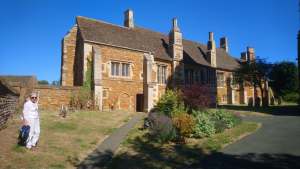
Early on the 10th, Sue and I drove to The Bede House in Lyddington. It was a sweltering morning, and exploring the cool interior of this remarkable historic building was a welcome relief. Originally part of the medieval palace of the Bishops of Lincoln, it passed into the hands of Sir Thomas Cecil, son of Queen Elizabeth I’s chief minister, around 1600. He converted it into an almshouse for twelve poor ‘bedesmen’ over the age of thirty, and two women over forty-five, all required to be free from lunacy, leprosy, or the French pox.
Apart from one other couple, we had the place to ourselves and wandered at leisure, soaking up the history and atmosphere through the many informative display boards. Before leaving, I picked up a bottle of ‘Wassail’ beer from the small gift shop for later enjoyment.


We next drove the short distance to the next historical site on our itinerary, Kirby Hall, one of England’s finest Elizabethan and 17th-century houses. Once again, the cool interiors of this magnificent, though partially derelict, building offered welcome respite from the intensifying heat outside. At the entrance, we collected the necessary audio guides and followed the tour through the house and gardens. Some rooms have been fully restored, while most remain in a dilapidated state, visible only through barred windows or closed doors.
In its heyday, this was an opulent residence, a striking contrast to the nearby remains of the medieval village of Kirby, much of which was demolished to build the hall. Its former inhabitants were employed as domestic staff. Before exploring the grounds, we enjoyed a picnic beneath the shade of a large chestnut tree, sharing our crumbs and crisps with one of the many resident peacocks strutting across the lawns. As before, we stopped at the gift shop on our way out, this time purchasing a flagon of scrumpy, which unfortunately turned out to have a rather unpleasant taste.
While Sue and I had our feet firmly on the ground, immersed in history, Ellis was up in the clouds once more, this time taking a powered flying lesson over the parched Northamptonshire fields from Sywell Aerodrome.


Over the following days, the heat continued to intensify, prompting me to revise the route of a planned 10-mile ramble with Sean to Arthingworth for lunch. Wisely, we opted instead for a more manageable five-mile walk, stopping for lunch at The Swan in Braybrooke. Despite the shorter distance, the heat took its toll, and we compensated for the considerable fluid loss with further vital refreshments at The Oat Hill in Little Bowden.
Sue was also braving the conditions, joining a U3A nature group ramble followed by lunch at the ‘not-so-wet’ wetlands of Cossington Meadows. Even as evening fell, the oppressive heat lingered across the UK, luring our group of friends outside for a relaxed chat while taking turns (or more often not taking turns) during the now-regular Thursday night pool sessions in the garden room.

The pool table saw further action the following evening as the male members of the clan gathered for a Pie and Pool night. That afternoon, the temperature had soared to an oppressive 42°C, and it barely relented by evening, making it far too muggy for the usual alternative activity of table tennis on the patio.
In response, Sue rallied the troops for an impromptu game of croquet on the lawn, which provided light-hearted entertainment until the midges became overly persistent. Eventually, we retreated to the welcome cool of the air-conditioned garden room, where we rounded off the evening with a series of ‘round robin’ pool matches.
The following morning, we travelled to Newbold Verdon for a BBQ lunch with Sarah and the family. It was another scorching day, which led to the cancellation of our usual walk with Mia. Leaving a panting canine in the cool of the house, we strolled to the village library to exchange a few jigsaws before Lee turned his attention to preparing lunch.
After several energetic rounds of hide and seek with an indefatigable Alice, lunch was eventually served, and a welcome calm settled over proceedings. We sat chatting on the patio, sheltered in the shade of the house, until 3 pm, when Sue and I had to leave for Willow Bank, we’d promised to join our next-door neighbours, Mike and Claire, for drinks at 4.
We arrived on time and enjoyed drinks and snacks until around 6 pm. Claire’s parents joined us for a short while before heading off for a fish and chip supper. Our hosts were eager to see the garden room, so we relocated there to round off the evening with more drinks, wrapping up around 7 pm.
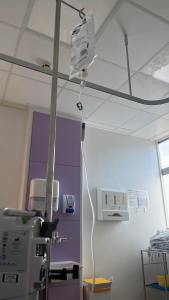
On Sunday, 14th August, Sarah woke feeling quite ill, unable to keep down any food or drink. We suspected she had picked up a bug. Lee contacted the doctor, who advised taking her to Leicester Royal Infirmary for rehydration. It was late that night when, after two bags of intravenous saline solution, she was finally well enough to return home.
In what seemed like sympathy, I also felt unwell the following morning and spent the next two days in bed with a temperature and stomach ache. Around the same time, Lee also succumbed to the mystery illness, though he managed to stay on his feet. The general suspicion is that we’d all suffered a bout of food poisoning, though it’s curious that Sue remained perfectly fine, suggesting the likely culprit was the mini sausage rolls, of which Sue had only one.
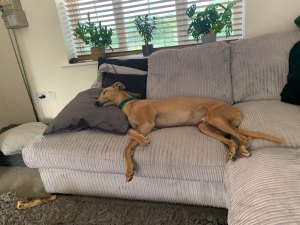
Harry sympathising with Sarah and me.
In between bouts of deep sleep, I still managed to organise the next away jaunt with my ex-rugby-playing chums. On the 12th of March next year, six of us will be flying out to Marrakesh in Morocco for a week, and a spot of desert camel riding.
The illness that affected both Sarah and me caused a bit of a hiccup for Ruth. She and Joey are booked on a cruise to Norway, which requires the permission of Ruth’s ex-partner to take Joey abroad. Initially, this was granted, but rather inconveniently, after everything had been booked, he withdrew it. This forced Ruth to apply to the court to ensure everything was kept legal.
She asked Sarah to accompany her to the hearing on Monday (given that Sarah works in the court system and knows the judge), but, unfortunately, Sarah was too ill. I was next in line to step in and provide moral support, but I too was out of action. Fortunately, a healthy friend of Ruth’s stepped in at the last minute. In the end, her ex failed to turn up at the hearing, and the ruling went in Ruth’s favour; she was granted permission to take Joey abroad.
Breaking News: It’s a boy! After Sarah’s latest scan, it was confirmed that another male will soon be joining the Price household. The family competition to guess the baby’s name will no doubt intensify as Christmas approaches. Hmmmm… could it be Christopher?
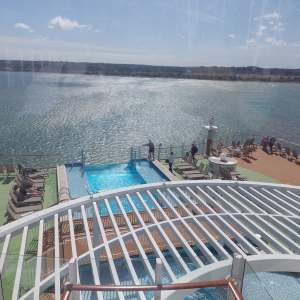
Early on Saturday, Jamie paid a brief visit with Ruth, Joey, and the dogs en route to Southampton. Thankfully, Ruth’s ex caused no further issues, and Joey was free to accompany his mother on a week-long cruise through the Norwegian fjords. Jamie was driving them to the port and staying overnight in a hotel before returning, while we took care of the dogs in the meantime. Everything went smoothly, Ruth and Joey set sail that evening, and after a night out in Southampton, Jamie returned to Willow Bank the following afternoon to collect the hounds.
Sue’s birthday fell on the following Tuesday (23rd), and as a gift, I decided to make use of our English Heritage membership by visiting a few of its properties. I booked a hotel for a couple of nights with the aim of exploring nearby Bolsover Castle. Originally founded in the late 11th century by William Peveril, one of William the Conqueror’s knights, the castle fell into neglect from the mid-14th century. Rising from its ruins, the Little Castle was built in 1612 by Sir Charles Cavendish as a retreat from his main residence at Welbeck.

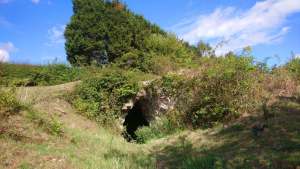
We travelled to the area on Monday morning, making our first stop in the small village of Langwith for a walk and to visit Langwith Cave, situated on the north side of the Poulter Valley, some six metres above the valley floor. The cave has yielded Neolithic remains, including evidence of human burial and a small fragment of an infant’s skull, an atmospheric and suitably ancient setting to begin our day.
We parked at the local pub and, guided by my GPS, enjoyed a short and pleasant walk past the church and into the small valley. A narrow wooden footbridge carried us across a crystal-clear stream, and from the opposite bank, we spotted the cave entrance. It was easy to access and, though not extensive, it was simple to imagine why it might have provided shelter in the distant past. At the rear, several small tunnels appeared to lead deeper into the hillside, though these were now blocked by roof debris and silty soil; who knows what secrets might lie beyond?
Our curiosity satisfied, we retraced our steps to the pub, then continued along the road before diving into Langwith Woods to begin a short but invigorating circular walk.
In the afternoon, I had arranged a private tour of Pin Hole Cave (also known as Hyena’s Den) at Creswell Crags. With our ramble complete, we drove a mile or so beyond the village to Poulter Country Park to begin the Archaeological Trail. There, we paused for a leisurely picnic lunch on a bench overlooking a small, attractive pond, sharing our crusts with a hungry shoal of fish before moving on just a few miles further.
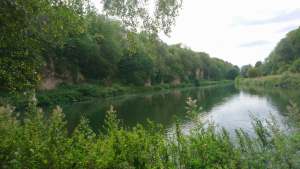
Creswell Crags is a spectacular magnesian limestone gorge straddling the border between Derbyshire and Nottinghamshire. The cliffs are dotted with numerous caves, fissures, and rock shelters, many of which have revealed remarkable secrets from our prehistoric past. Archaeologists have been excavating the area since the 19th century, when Victorian explorers first unearthed artefacts beneath the cave floors. In Pin Hole Cave, for instance, evidence was found of its use both as a hyena’s den and as a human habitation.
We had booked parking for three hours and arrived at 2 pm, giving us ample time, an hour and a half, to explore the exhibition and the crags independently before our guided tour began at 3:30 pm. Sue and I had visited many years ago, when the site was little more than a modest brick-built museum housing a handful of artefacts. The trail back then was overgrown and rife with stinging nettles, weaving past several barred cave entrances along a silted lake. As a child, I had cycled here with friends on several occasions to play in the caves, then unguarded by metal doors and largely undiscovered, hidden behind dense mats of creepers and a formidable army of nettles and brambles.
After presenting our membership cards and enjoying a well-earned ice cream, we began exploring the exhibition hall. A short video tracing the history of the crags through the millennia provided an engaging and informative introduction to the displays. All the artefacts on show had been recovered from within or just outside the caves and were thoughtfully presented in their archaeological context. As always, we lingered over the information boards, with particular interest in those detailing the presence of a hyena family that once occupied the area.
Though showers had been forecast, we managed to remain dry as we set out on the trail encircling the lake, once a wallowing spot for hippos. A few spots of rain threatened, but nothing came of it, and we completed the walk in comfort before returning to the centre for refreshments in the café ahead of our scheduled meeting with the guide.


Our first guided stop was the exhibition hall, where we were treated to a more in-depth explanation of each item we had seen earlier. Pin Hole Cave is the least visited of the caves on site, and one of the furthest from the centre. It was on our way there that the rain began, and it was a welcome relief to seek shelter in this cliff dwelling. We had been provided with hard hats and lamps for our underground excursion, which proved essential for spotting any details in the dim light.
Excavations are still ongoing at the site, and there is much evidence of the work. This cave is significant not only for its past human habitation but also because it once housed a family of hyenas. Archaeologists are still carefully working through the habitation levels, so we had to be cautious about where we stepped and what we touched. Despite the precautions, we could see small bones protruding from the walls alongside other fascinating structures.

By the time we left the cave, it was 5 pm, and the rain was pouring down. Three bedraggled modern hominids eventually reached the sanctuary of the exhibition building, glad to be out of the weather.
It took a tricky half-hour drive along narrow country lanes to reach our accommodation for the next two nights, the Twin Oaks Hotel, conveniently situated near the M1 motorway. We enjoyed our evening meal in the hotel restaurant, and then finished the night watching TV in our room, which offered a lovely distant view of the next day’s adventure: Bolsover Castle.
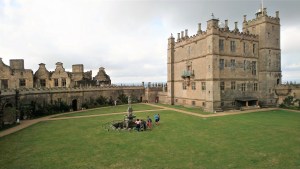

After breakfast, on a bright and humid morning, we set off for Bolsover. The present castle, built in the early 17th century, stands on the earthworks and ruins of a 12th-century medieval fortress. The first structure of the current castle was constructed between 1612 and 1617 by Sir Charles Cavendish. Finding the car park situated below the castle walls proved a little tricky, as the entrance was narrow and not particularly obvious. We were the first car there.
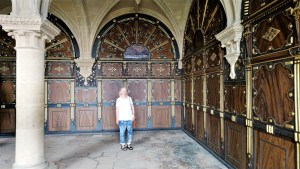 We spent a couple of hours exploring the site. The Cavendishes certainly led an enviable life, and many of the rooms in the Little Castle have been preserved as well as possible, making it easy to imagine the opulent lifestyle they enjoyed. Charles, in addition to being a talented musician and a supporter of the arts, was an accomplished horse rider. He loved riding through the adjoining deer park with his good friend, who lived in a Baroque-style manor house across the valley with the 4th Earl of Scarsdale.

There is a five-mile circular walk between these two grand buildings. Having exhausted our curiosity about Bolsover Castle, we set off to follow its course. The descent through the town, down to the valley floor, was very steep, and it didn’t bode well for our return, especially as the humidity had increased. Passing by several ponds and lakes, part of the deer park, we struggled to cross a recently harrowed field before making our way across the M1 motorway via a small road bridge. Another steep climb through fields brought us to the ha-ha surrounding the frontage of Sutton Scarsdale Hall.
The ruins are the remnants of a once majestic interior, visible only through the ‘skeleton’ of the building. Extensive restoration is currently underway, and access is limited. Sue couldn’t manage the ha-ha and decided to stay behind while I had a quick look at the fence barring entry. On further inspection, I discovered a small car park at the rear of the property, being used by the masons working on the restoration. After re-joining Sue, we decided to finish our exploration and return to the Hall.
The route back was easier, crossing the motorway via a field tunnel. Upon reaching the foot of the slope to the castle, I left an exhausted Sue to rest while I fetched the car, as the humidity was taking its toll on her. It had taken us a couple of hours to walk the circular path, but just ten minutes to drive back to the Hall. The masons had left, but two other cars were parked up with equally curious tourists, photographing the relics of the building. We walked around Sutton Scarsdale Hall, stopping only to read the few information boards we came across.
It’s no surprise that the downfall of the Hall was due to the careless use of the family finances; trying to keep up with the Cavendishes comes with its problems! The Hall, with its lavish decorations, must have been a horrendous money-pit. John Arkwright, a descendant of the industrialist Richard Arkwright, bought the Hall, but in 1919, the family sold it to a company of asset strippers. Many of its finely decorated rooms were sold off as architectural salvage, and the house was reduced to a shell. Three of the interiors are now displayed at the Museum of Art in Philadelphia.
Lazily, we chose to eat in the hotel restaurant that night, retiring early to our room after a short walk around the grounds. We watched TV before settling into sleep.
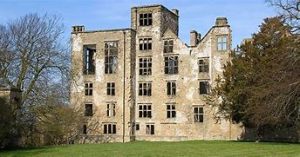
As it was just a couple of miles away, after breakfast, we decided to visit Hardwick Old Hall. Built between 1587 and 1596 by Bess of Hardwick, one of the richest and best-connected women of the Elizabethan age, the Hall was an impressive structure. Unfortunately, it too was undergoing extensive renovation, with masons hard at work chipping away at the stonework behind fencing and scaffolding. However, the delightful drive through its associated deer park and the abundance of informative boards made up for our inability to fully roam this relic of the past.
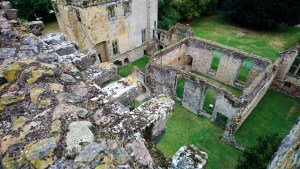

The main focus of today was to visit Ashby-de-la-Zouch Castle, and that is where we headed next. A half-hour drive along country roads in a part of the country I had never been brought us to the town of Ashby, where we (with difficulty) managed to find and fit into the only space left in the municipal carpark close to the castle. A short walk brought us to this once 12th-century manor house. William, Lord Hastings, adapted the relatively modest manor house in 1472–3, but by the time of his sudden fall from grace and execution in 1483, only about half of his grand design had been realised. The castle remained in use as the main family seat of his descendants, playing a prominent part in the Civil War, when it was held for the king. It is probably best known for when, in 1819, the novelist Sir Walter Scott published a medieval romance, Ivanhoe. A tournament scene in the novel was set at Ashby, and since then, many visitors have flocked to see the castle ruins, including us!
We followed an excellent audio trail around the building and grounds, with a script that was quite humorous, gently transporting you back in time and filling your mind with visions of castle life and the privileges of the aristocracy. Well done, English Heritage, a brilliant introduction to the history of the castle. With still an hour left on our parking ticket, we chose to investigate the High Street, and we were impressed. A lovely array of shops and plenty of medieval frontages to stand and stare at. There was a charming indoor market, where I bought myself a watch with a big enough dial for me to read without searching for my glasses. A bargain at £6.95!
The route home took us through Newbold Verdon, so we called in to see Sarah and the family. Sadly, Alice was at the child-minders, and Mia was with the dog-walker, so we only stayed long enough to have coffee and a chat with Sarah and Lee. They seem well and are getting prepared for the arrival of their baby boy. We also called into a small shoe outlet warehouse in the village before continuing our journey home, and yet again I dipped into my wallet, this time buying a pair of leather shoes for £5.95!
The following day, I had organised a walk with Sean to Wadenhoe, but it turned out to be a much busier day than planned. Wadenhoe was chosen because a friend of ours (a rugby chum) is buried there, and we wished to visit his grave and interrogate the landlord of the local pub about a few issues concerning his death.
As I picked Sean up at 8.30 am, he took a phone call from Peter Howard, who is also a friend and director of Leicester Tigers. I had been planning to watch the Tigers that evening play Newcastle on TV, but Peter offered us four complimentary corporate tickets for the game. We accepted.
 It was a 35-minute drive to the King’s Head in the gorgeous 800-year-old village of Wadenhoe, and luckily, the landlord came to speak to us as we parked. Our rugby chum had died in 2016 under mysterious circumstances, and it was rumoured that his wife had “bumped” him off. The coroner decreed that he should be buried rather than cremated, and the last we heard was that his son (from a previous marriage) had pushed for his body to be exhumed and analysed. The landlord informed us that the body hadn’t been “dug up,” but his wife was not liked in the village and was suspected of skullduggery, as at the time, she was having an affair. Soon afterwards, she sold the house and moved away with her lover. Sadly, despite his being a multi-millionaire, his grave is unkempt and overgrown. Rumours still abound.

Our circular walk of 8 miles took us to Lyvedon New Build, an unfinished Elizabethan summer house constructed for Sir Thomas Tresham in 1604–05. Unlike myself, Sean hadn’t been here before, so we spent some time satisfying his curiosity before we carried on with our ramble, blackberry scoffing at every opportunity, with the occasional munching of plums and apples picked along the way. We arrived back at the riverside pub in time for a very acceptable ploughman’s lunch and a couple of refreshing drinks before returning to Harborough by 3 pm.
Early in the evening, Sean drove into Leicester, picking myself, Jim, and Paul up on the way. We had a very substantial three-course meal in the Director’s Lounge before making our way to our seats on the halfway line for a 7 pm kick-off. At halftime, we enjoyed cheese, crackers, and chutneys washed down with refreshments in the lounge before again taking our seats. At the final whistle, the Tigers had run out winners against a very useful and speedy Newcastle side. In celebration, we scoffed after-match sausage rolls, washed down with suitable lubrication. On the way back to Harborough, we paused for further refreshments at the Coach and Horses in Kibworth. A long, tiring day, but greatly enjoyable.
 Palmer Family
Leave a comment